


Craft
How a Handmade Moroccan Caftan Is Made
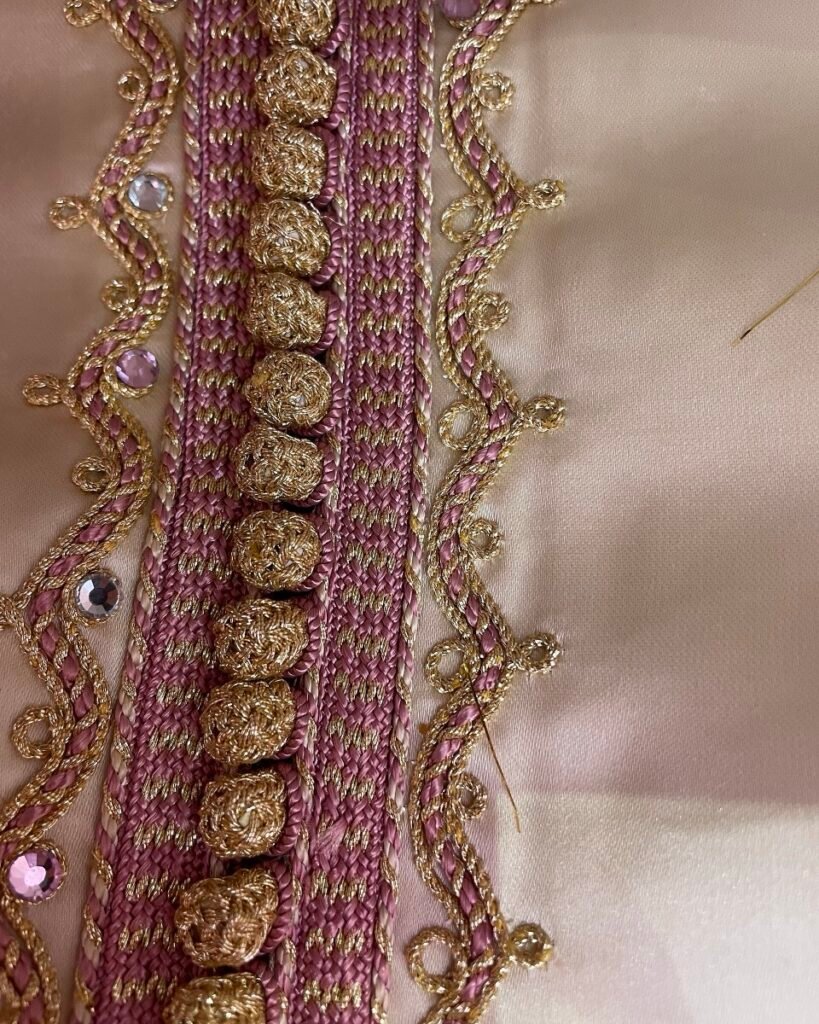
When you look at a Moroccan caftan from a distance, you see colour and elegance. When you look closely, you discover something else: thousands of tiny gestures made by hand. Here is how a traditional caftan is born in an atelier of the Marrakech Medina.
1. Choosing the fabric and the design
Everything starts with the fabric. Crêpe is the most popular for its fluid drape; velvet and brocade are chosen for ceremonial pieces; lighter fabrics are perfect for summer. The artisan then decides on the cut, the colours of the braid and the type of embroidery. For a made-to-measure piece, this is when the client’s measurements are taken. (Curious about fabrics? Read our guide to caftan fabrics.)
2. Cutting
The tailor — the khayat — cuts the pieces of the caftan. The cut of a traditional caftan is simple and straight, so the beauty comes from the finishing and from how the fabric falls on the body.
3. The sfifa: a braid twisted by hand
The sfifa is the decorative braid that frames the neckline, the front opening and the sleeves. It is made from silk or rayon threads, twisted and braided by hand, sometimes by two people working together — one holding and turning the threads while the other braids. It is then sewn onto the caftan with small, invisible stitches. A good sfifa gives the caftan its structure; a bad one ruins even the most beautiful fabric.
4. The aakad: buttons knotted one by one
The aakad are the small knotted buttons that close the caftan from collar to waist. Each one is made individually from thread, and a single caftan can have dozens — sometimes more than a hundred. Matching loops are made on the opposite side. It is slow, meticulous work, and it is one of the clearest signs of a truly handmade piece.
5. Embroidery: randa, tarz and beadwork
Depending on the model, the caftan is then embroidered:
- Randa: a delicate needle-lace worked around the collar and cuffs.
- Tarz: embroidery with gold, silver or silk thread, like the famous tarz fassi from Fez.
- Beadwork: beads, sequins and crystals sewn one at a time to create patterns.
A richly embroidered piece can take several weeks of work.
6. Assembly, fitting and finishing
The caftan is assembled, lined if needed, and tried on. Sleeves, length and waist are adjusted so the piece falls perfectly. Finally, it receives its belt — the mdamma — in embroidered fabric or gold-tone filigree.
Why it matters
Machine-made “caftans” can imitate the look of sfifa and buttons, but not their quality or their soul. A handmade caftan is stronger, more beautiful and supports a whole community of artisans who keep this knowledge alive. Learn how to spot real handmade clothing, or visit our boutique to see the work up close.
Found a piece you love? We answer on WhatsApp.